Auto Industry Staffing
Auto Dealership Staffing in Phoenix: 10 Jobs That Don't Always Need Another Full-Time Employee
Walk through almost any busy auto dealership and you'll see an interesting workforce problem.
The dealership may have plenty of highly skilled people.
Sales professionals.
Finance managers.
Service advisors.
Technicians.
Parts specialists.
Managers.
Yet some of those employees regularly spend time doing work that doesn't require their specialized skills.
A salesperson moves vehicles around the lot.
A manager helps prepare for a weekend sales event.
A service employee gets pulled into an inventory project.
Someone needs vehicles relocated.
A shipment arrives and suddenly everyone available gets recruited to help.
None of those tasks are necessarily unimportant.
The problem is who is doing them.
For Phoenix auto dealerships, the workforce question isn't always:
“Do we need another full-time employee?”
Sometimes it's:
“Do we need additional labor capacity for this particular job, project, or period?”
Those are two very different questions.
The Hidden Cost of Using Expensive Talent for General Work
Imagine one of your strongest salespeople spending an hour moving vehicles.
They're capable of doing it.
But capability isn't the issue.
The question is:
What's the highest-value thing that employee could be doing during that hour?
Probably selling.
The same principle applies throughout a dealership.
If managers, salespeople, service professionals, or other specialized employees regularly perform general operational tasks because nobody else is available, the dealership may have a workforce allocation problem.
Every Employee Has an Opportunity Cost
Payroll isn't the only cost of labor.
There's also the value of the work that employee isn't doing.
Suppose a manager spends three hours solving a temporary labor problem.
The dealership paid for those three hours regardless.
But what didn't happen?
Coaching?
Customer follow-up?
Sales management?
Inventory review?
Process improvement?
Vendor management?
That's opportunity cost.
This Doesn't Mean Every Small Task Needs a Temporary Worker
Sometimes jumping in is simply part of teamwork.
Managers should occasionally help.
Salespeople will sometimes move cars.
Everyone may pitch in during an unusual situation.
The warning sign is when:
“Everybody just helps”
becomes the permanent workforce model.
If highly valuable employees are repeatedly pulled away from their primary responsibilities, it may be time to examine the system.
1. Vehicle Movement
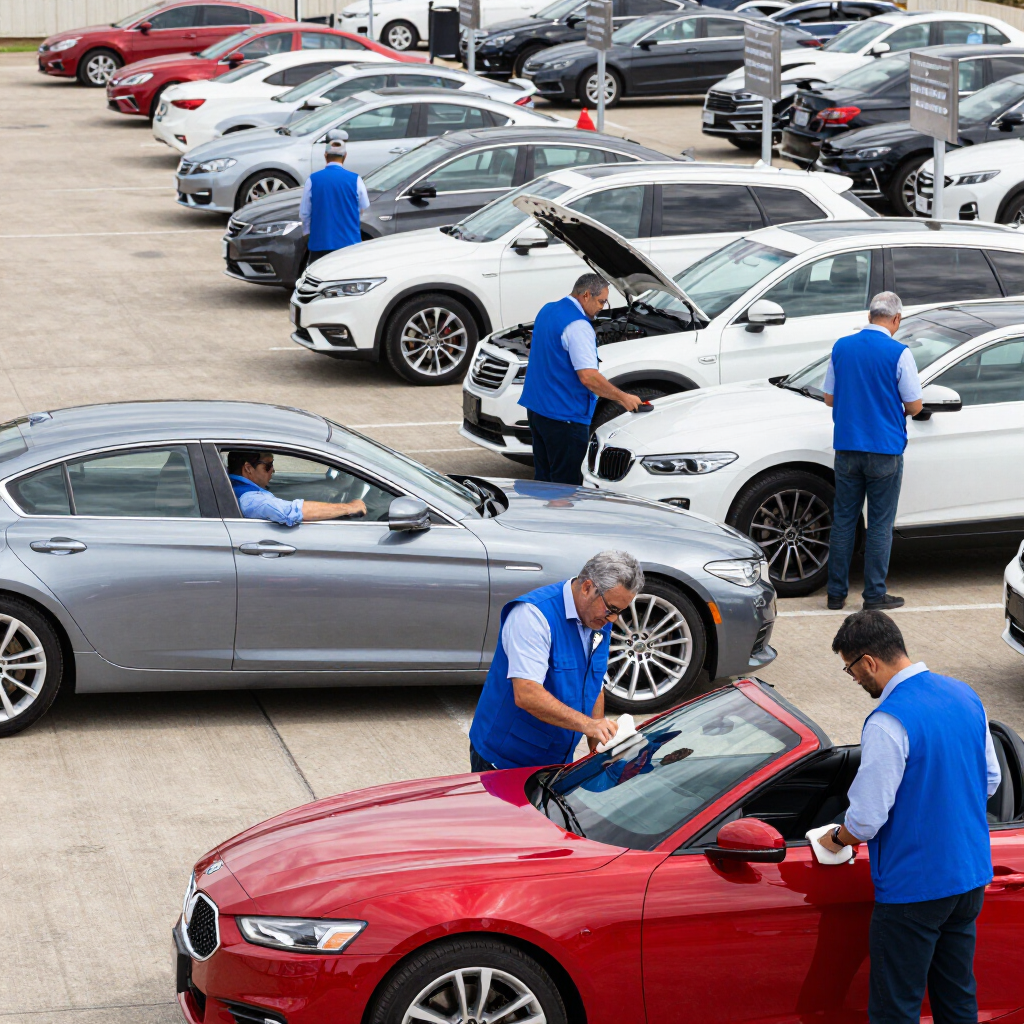
Dealerships move a lot of vehicles.
Around the lot.
Between areas of the property.
To designated staging locations.
For operational reasons.
Depending on the assignment, appropriately screened and authorized temporary workers may be able to support certain vehicle-movement functions under the dealership's procedures.
This can free specialized dealership employees to remain focused on their primary work.
Vehicle Movement Sounds Simple—Until Volume Increases
Moving three vehicles isn't a workforce strategy.
Moving dozens—or more—within a specific timeframe is different.
Now you need:
Coordination.
Keys.
Instructions.
Safe movement procedures.
Parking plans.
Communication.
Supervision.
The more vehicles involved, the more the task becomes a small logistics operation.
2. Lot Organization Projects
Dealership lots change.
Inventory arrives.
Inventory leaves.
Sections need reorganizing.
Vehicles may need repositioning for:
Sales events.
New inventory.
Used inventory.
Promotions.
Construction.
Maintenance.
Operational changes.
Instead of pulling employees from across the dealership, temporary general labor may provide additional capacity for appropriate tasks.
Organize the Work Before Adding People
If 10 workers arrive and nobody knows where vehicles or materials belong, you've simply created 10 confused workers.
Before the project begins, determine:
What's moving?
Where is it going?
Who controls the keys?
Who gives instructions?
What's the sequence?
Who signs off when an area is complete?
Labor works better when the process works.
3. Inventory Projects
Dealership inventory creates occasional labor-intensive projects.
Depending on the dealership and the work involved, temporary employees may support appropriate inventory-related tasks such as:
Physical counting assistance.
Organizing materials.
Tagging or labeling where applicable.
Moving approved items.
Data-support tasks where properly trained and authorized.
General project assistance.
The exact responsibilities should always match the employee's qualifications, access permissions, and the dealership's procedures.
Don't Pay Permanent Payroll for Temporary Projects Without Asking Why
Suppose a project requires six additional people for four days.
Does the dealership need six additional permanent employees?
Probably not solely because of that project.
That's where flexible staffing can become useful.
Match the workforce duration to the workload duration.
4. Dealership Sales Events
A major weekend promotion can change dealership activity quickly.
More traffic.
More vehicles positioned.
More signage.
More customer movement.
More cleanup.
More setup.
More operational demands.
But that increased labor need may last:
One day.
One weekend.
Several days.
That's exactly the type of situation where flexible workforce capacity can make sense.
Staff the Event Without Permanently Staffing the Dealership for the Event
This is the same principle we've discussed with event staffing.
Businesses shouldn't necessarily carry peak workforce capacity every day of the year.
A dealership might maintain:
Core workforce
Flexible event capacity
Contingency capacity
That can create a more adaptable operation.
5. Event Setup and Breakdown
Dealership events don't magically assemble themselves.
Someone may need to help with appropriate tasks involving:
Tables.
Chairs.
Signs.
Promotional materials.
Guest areas.
General setup.
Cleanup.
Breakdown.
Again, ask whether your highest-value dealership employees should spend hours performing those tasks.
Sometimes they should help.
But they shouldn't automatically become the setup crew because nobody planned labor.
6. General Labor During Facility Projects
Dealerships occasionally undergo:
Remodeling.
Office moves.
Department reorganizations.
Storage projects.
Property cleanup.
Furniture moves.
Signage changes.
Other facility projects.
Some work requires licensed or specialized professionals.
That should remain with properly qualified providers.
But other general-labor portions of a project may be appropriate for temporary support.
Know the Boundary
This is important.
Temporary staffing isn't a shortcut around qualifications.
If work requires:
Licensing.
Specialized training.
Specific certifications.
Specialized equipment.
Regulated responsibilities.
then the employee needs the appropriate qualifications and authorization.
Flexible labor should match the work—not simply be placed wherever someone is needed.
7. Seasonal Cleanup and Property Projects
Phoenix creates its own property-maintenance realities.
Dust.
Heat.
Monsoon conditions.
Outdoor exposure.
Large lots.
Seasonal projects.
A dealership may periodically need additional general labor capacity for appropriate cleanup or organizational projects.
That doesn't necessarily justify maintaining extra permanent headcount year-round.
Arizona Working Conditions Matter
If temporary workers will be outdoors, tell them.
Phoenix heat isn't a footnote in the job description.
The actual working environment should be communicated during recruiting.
Employers should follow applicable workplace safety requirements and establish procedures appropriate to the conditions and work being performed.
Accurate job descriptions help candidates make informed decisions.
8. Auction-Related Operational Support
Dealerships and auto auctions are naturally connected.
Vehicles move through the automotive ecosystem.
Depending on the dealership's processes and the assignment, temporary employees may support appropriate operational work associated with vehicle movement and other general functions.
This is particularly relevant to Flat Staffing because auto auction staffing is an area where we've developed real operational experience.
Auction Experience Can Translate Into Automotive Workforce Knowledge
Someone familiar with automotive environments may already understand that vehicle-related operations require:
Attention.
Communication.
Following procedures.
Awareness of pedestrians and other vehicles.
Care around client property.
Consistency.
That doesn't automatically qualify someone for every dealership position.
But relevant environment experience can be valuable.
9. Short-Term Backlog Projects
Every business develops backlogs.
Dealerships are no different.
Sometimes there's a pile of work that isn't enough to justify another permanent employee—but it's too much for the existing team to keep ignoring.
That's a perfect question for workforce planning.
Ask:
Is this workload permanent?
Temporary?
Seasonal?
Project-based?
Recurring?
If the backlog is temporary, a temporary workforce solution may fit better than permanent hiring.
But Be Careful: A "Temporary Backlog" Can Become Permanent
Suppose every month you need extra workers to catch up.
At some point, the workload may no longer be temporary.
The business should ask:
“Is this actually our normal operating level?”
If the answer is yes, permanent hiring may be more appropriate.
Temporary staffing should provide flexibility.
It shouldn't hide chronic understaffing forever.
10. Unexpected Workforce Gaps
Someone resigns.
An employee has an extended absence.
A project expands unexpectedly.
A busy period arrives sooner than anticipated.
The dealership suddenly has less workforce capacity than the operation requires.
Depending on the position, temporary staffing may help bridge certain operational gaps while the dealership determines the longer-term solution.
A Temporary Worker Can Buy You Something Extremely Valuable: Time
This benefit gets overlooked.
Imagine a permanent employee leaves Friday.
Management immediately feels pressure:
“Hire somebody.”
That's when businesses make poor hiring decisions.
If temporary support can appropriately cover portions of the workload, management may have more time to recruit the permanent employee carefully.
That's valuable.
Don't Let Urgency Choose Your Permanent Employees
A vacant position creates pressure.
Pressure creates shortcuts.
The first acceptable candidate suddenly looks excellent.
But hiring mistakes can last much longer than staffing shortages.
Flexible workforce capacity can sometimes reduce the pressure to make an immediate permanent decision.
Temporary Staffing vs. Temp-to-Hire
These aren't the same strategy.
Temporary Staffing
The business primarily needs workforce capacity for a limited period.
Temp-to-Hire
The business may ultimately need a permanent employee but wants an evaluation period before making that decision, subject to the staffing arrangement.
Both can be useful.
But the business should understand which problem it's solving.
Temp-to-Hire Can Be Particularly Useful for Culture and Reliability
A résumé can tell you:
Where someone worked.
How long.
What they say they can do.
It cannot fully tell you:
Will they arrive every day?
How do they communicate?
How do they treat coworkers?
How do they respond to supervision?
Do they learn?
Do they take care of the workplace?
Do they fit the environment?
Actual performance provides information interviews cannot.
Don't Treat Temp-to-Hire Like an Endless Audition
If someone is doing excellent work and the dealership intends to hire them, understand the conversion terms and make decisions appropriately.
Employees deserve clarity too.
Temp-to-hire should create a pathway.
It shouldn't become:
“Maybe someday.”
Where Temporary Staffing May Not Be the Right Answer
Flexible staffing isn't appropriate for everything.
A dealership may be better served by permanent hiring when:
The workload is consistently full-time.
The position requires deep institutional knowledge.
The employee manages important long-term customer relationships.
The role requires specialized qualifications.
Continuity is especially important.
The organization clearly has sustainable permanent demand.
Sometimes the correct workforce decision is:
Hire the employee.
The Goal Isn't Maximizing Temporary Labor
This is worth emphasizing.
A staffing agency shouldn't want every business to replace permanent employees with temporary workers.
Strong businesses need strong core teams.
Temporary staffing should solve specific workforce problems.
Think:
Permanent core workforce
Flexible capacity
rather than:
Temporary workers everywhere.
Build a Dealership Workforce Capacity Map
Take every recurring dealership function and put it into one of four categories.
Work TypeWorkforce ApproachCore, ongoing strategic workUsually permanent workforceSpecialized/qualified workAppropriately qualified workforceVariable recurring workConsider flexible capacityShort-term project workConsider temporary/project staffing
This simple exercise can reveal where your labor is being misallocated.
Then Ask One Powerful Question
For every task:
“Does the person doing this need to be the person doing this?”
Your general manager?
Sales manager?
Top salesperson?
Service advisor?
Technician?
Could an appropriately trained support employee handle the task instead?
That's not about reducing anyone's value.
It's about using their value correctly.
Don't Use Your Best People as Permanent Shock Absorbers
Every dealership has them.
The people who solve everything.
Someone calls out?
Call Mike.
Cars need moved?
Ask Maria.
Event setup?
Grab the sales team.
Inventory problem?
The manager will handle it.
Eventually your best employees spend half their time compensating for missing workforce capacity.
That's expensive.
And frustrating.
Protect Revenue-Producing Employees
This principle applies especially strongly in dealerships.
Sales professionals should have time to sell.
Managers should have time to manage.
Technicians should have time to perform skilled technical work.
Service advisors should have time for customers.
Every hour those employees spend unnecessarily performing unrelated general tasks carries an opportunity cost.
Measure the Hours
For one month, track how much time specialized employees spend on general operational work.
You may be surprised.
Suppose several employees collectively spend dozens of hours each month on tasks that could appropriately be handled another way.
Now you can compare:
Cost of current approach.
Cost of additional permanent support.
Cost of temporary support.
Cost of outsourcing.
Operational benefit.
That's workforce planning.
The Cheapest Hour Isn't Always the Cheapest Solution
Businesses naturally compare hourly labor costs.
They should.
But consider the value produced during that hour.
Paying a highly productive salesperson to perform a general task may technically cost nothing additional because they're already scheduled.
But there's still an opportunity cost.
Labor cost and labor value aren't identical.
Build Flexible Capacity Before You Need It
Don't wait until Saturday morning to discover you're overwhelmed.
If your dealership regularly has:
Large weekend promotions.
Monthly inventory projects.
Auction-related workload.
Seasonal property projects.
Recurring events.
predict them.
Now flexible staffing becomes planned capacity instead of emergency labor.
Share the Calendar
Tell your staffing partner:
Major sales event in three weeks.
Inventory project next month.
Property project coming.
Auction activity increasing.
Facility changes expected.
Exact numbers can come later.
Visibility helps recruiting start earlier.
Automotive Staffing Should Be Relationship-Based
The more frequently workers return to the same dealership, the more valuable continuity can become.
They begin learning:
Where things are.
Who supervisors are.
How the operation works.
What standards matter.
What the client expects.
Whenever practical, good performers should be considered for recurring appropriate assignments.
Temporary Doesn't Have to Mean Random
One of the biggest misconceptions about staffing is that every morning should bring completely different people.
Not necessarily.
A strong flexible workforce can include recurring temporary employees who become familiar with the client's operation.
That's especially useful in automotive environments.
Communicate Performance Back to the Staffing Company
Tell the agency:
“Bring her back.”
“He's doing excellent.”
“She learns quickly.”
“He's consistently early.”
Don't only communicate complaints.
Positive feedback helps the staffing provider understand who fits your operation.
And Communicate Problems Quickly
If someone isn't meeting expectations, say something.
Maybe coaching solves it.
Maybe the job wasn't properly explained.
Maybe there's a mismatch.
Maybe replacement is appropriate.
Waiting weeks helps nobody.
Safety and Vehicle Movement Require Clear Responsibilities
Automotive environments deserve particular care because workers may operate around moving vehicles, pedestrians, equipment, customer property, and active work areas.
Before an assignment begins, the staffing provider and dealership should clearly understand responsibilities related to job duties, qualifications, instruction, supervision, safety, and incident communication.
Businesses should consult appropriate safety, insurance, and legal professionals when necessary regarding their specific arrangements.
How Flat Staffing Supports Phoenix Automotive Businesses
Flat Staffing has served the Phoenix Valley since 2018.
Our automotive workforce experience includes supporting auto-auction operations, giving our team practical familiarity with recurring sale-day staffing, early schedules, attendance, vehicle movement environments, outdoor conditions, and flexible workforce requirements.
We also support workforce needs across:
- Auto Auctions
- Auto Dealerships
- Warehousing
- Distribution
- Logistics
- Manufacturing
- Events
- General Labor
Our objective isn't convincing a dealership that every position should be temporary.
It's helping determine:
Where does flexible labor actually make operational sense?
Local Recruiting Matters in Automotive Staffing
A dealership in Peoria doesn't necessarily recruit from exactly the same workforce as one in Chandler.
Location matters.
Shift matters.
Commute matters.
Schedule matters.
Flat Staffing works throughout the Phoenix Valley, including:
Phoenix.
Glendale.
Peoria.
Scottsdale.
Tempe.
Mesa.
Chandler.
Gilbert.
Avondale.
Goodyear.
Surprise.
Buckeye.
For hourly support positions, proximity can sometimes be an important recruiting advantage.
Leadership Behind Flat Staffing
Flat Staffing is led by Nino Mihilli, and one of the workforce principles behind the company is simple:
Put people where they create the most value.
That doesn't mean every employee has to generate revenue directly.
Support positions create enormous value.
But businesses should be intentional about who is doing what.
A great salesperson shouldn't routinely become the lot's general labor solution.
A manager shouldn't constantly become emergency staffing.
A technician's specialized time shouldn't be consumed by work someone else could appropriately perform.
Good workforce planning isn't simply about having enough people.
It's having the right people doing the right work at the right time.
You can learn more about Nino's approach to business and leadership at NinoMihilli.com.
The Bottom Line
Phoenix auto dealerships don't necessarily need another permanent employee every time workload increases.
Sometimes they need:
Additional vehicle-movement capacity.
Lot support.
Inventory project help.
Sales-event labor.
Setup and breakdown support.
General project labor.
Seasonal cleanup assistance.
Auction-related support.
Backlog help.
Temporary gap coverage.
The question isn't:
“Can a temporary worker do this?”
The better question is:
“What workforce model makes the most sense for this specific work?”
Sometimes the answer is temporary staffing.
Sometimes it's temp-to-hire.
Sometimes it's outsourcing.
Sometimes it's redistributing work.
And sometimes the answer is absolutely:
Hire another permanent employee.
The strongest dealership workforce isn't the one with the fewest employees or the most employees.
It's the one that uses its people intelligently.
Frequently Asked Questions
What types of temporary workers can auto dealerships use?
Depending on the dealership, staffing provider, employee qualifications, insurance requirements, and job duties, temporary workers may support appropriate vehicle movement, lot organization, event setup, inventory projects, general labor, short-term projects, and other operational functions.
Can temporary workers drive dealership vehicles?
Whether a temporary employee can perform vehicle-movement duties depends on the specific assignment, staffing arrangement, driver requirements, insurance considerations, screening, authorization, and dealership procedures. These requirements should be clarified before the assignment begins.
When should a dealership use temporary staffing instead of hiring?
Temporary staffing may make sense when workload is short-term, project-based, seasonal, variable, or needed to bridge a temporary workforce gap. Consistent long-term workload may justify permanent hiring instead.
Can dealerships use temp-to-hire?
Depending on the staffing provider and position, temp-to-hire arrangements may allow businesses to evaluate an employee's actual performance before permanent conversion. Employers should understand conversion terms before the assignment begins.
How can dealerships decide whether they need more staff?
Track workload, overtime, backlogs, employee utilization, time specialized employees spend on general tasks, seasonal demand, and recurring projects. Then determine whether the underlying need is permanent, variable, temporary, or project-based.